
Before you order
Finishes, profiles and widths of our steel wedding bands
The same band changes completely depending on how the surface is finished, how much curve the profile has and how many millimetres wide it is. Here are the options, so you can look at them closely before deciding. Each model in the catalogue allows some of these variants and not others: its product page shows only the ones that can be made on that piece.
01 · The profile
How it sits on the finger
The profile is the shape of the band in cross-section, what you see if you look at it edge-on. It does not show in a front-facing photograph and yet it is what you notice most once it is on.
Half-round profile, edge-on
Half round
The outer face is curved, like half a tube. With no sharp edges, light slides across the whole surface and the piece looks slightly slimmer than it is. This is the classic wedding band profile.
Flat profile, edge-on
Flat
The outer face is straight and the edges stay defined. It emphasises the width and gives a contemporary, more assertive look. It is the profile on which grooves and raised engraving read best.
In both, the inside is curved and polished — what is known as comfort fit: it passes the knuckle without forcing and then settles.
02 · The width
Three millimetres change everything
We work in three widths at the bench. On a screen they look alike; on the hand they have nothing in common. Calibrate the ruler with a card and compare them at real size.
Hold any card —bank card, travel pass, gym card— against the rectangle and move the slider until the edges line up.
The three widths together in one photo
03 · The finish
The surface is the aesthetic decision
Everything below is done on the same piece of 316L steel: what changes is how the outer face is treated. One practical note before choosing: the more matt a finish is, the less daily wear shows on it; the more shine it has, the more it shows.
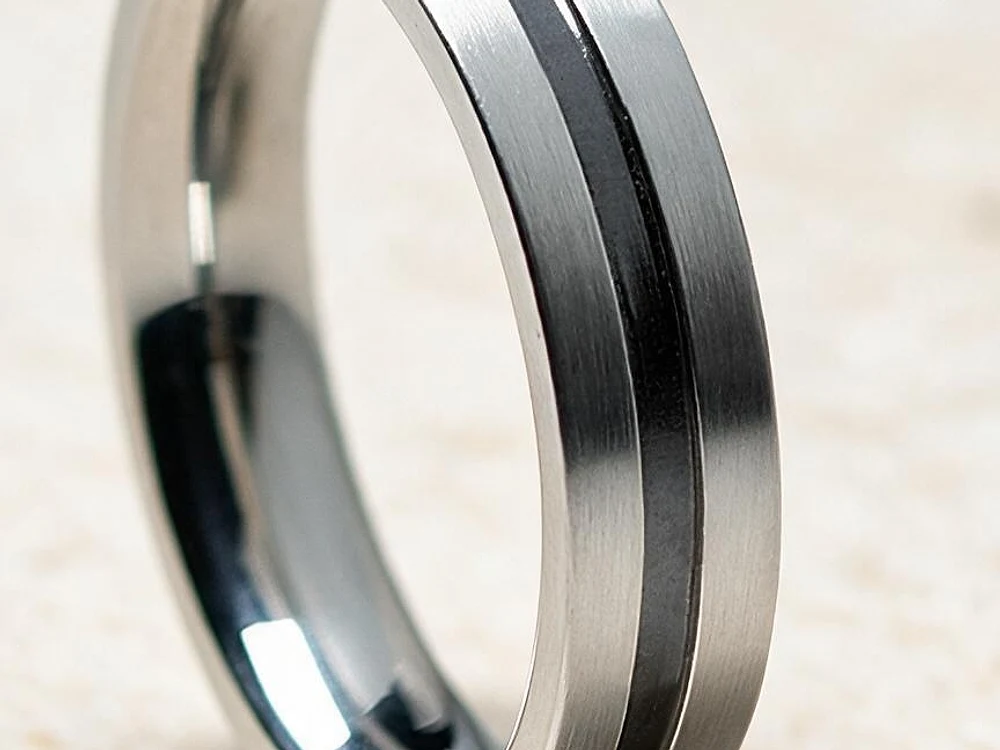
Satin standard
The finish the catalogue comes in unless you ask for another. A matt, even surface, brushed in a single direction. It is the one that hides wear best and asks for the least care.
Rustic brushed
Rustic brushed
Irregular lines with no fixed direction, made by hand one at a time. No two pieces come out the same. It is the finish where you can most tell it was worked and did not come out of a mould.
Cross brushed
Cross brushed
Parallel lines running across the band from side to side, regular and evenly spaced. Ordered and graphic: this is the brushing that works on bands with straight lines.
Micro hammered
Micro hammered
A small, repeated strike across the whole surface. It leaves a fine, regular texture that breaks the light at many points, giving a stippled sparkle rather than a clean reflection.
Hand hammered
Hand hammered
The same principle but with a larger, uneven strike. You can see each facet individually and every band comes out different. It is the finish with the most character of any we make.
Mirror polished
Mirror polished
A mirror. It is the one that shines most and reflects most of what is around it. It is also the one that shows day-to-day marks soonest, although we can refinish it at the workshop whenever you like.
04 · The extras
And two things that add on
Unlike the profile, the width and the finish —where you pick one— these two can be added on top of whatever you have already chosen.
Gold plating
Gold plating
A layer of gold over the steel, changing the colour of the piece without changing what is underneath. There are already plated models in the catalogue so you can see the tone before ordering it.
The resin colours, together
Coloured epoxy resin
Coloured resin set into the groove or channel of the band. It is the way to bring colour into a steel band without resorting to another metal, and to tell the two pieces of a pair apart.
How to order
Three steps and it is on the bench
- 1Choose the modelIts page shows only the variants that can be made on that piece, with what each one adds.
- 2Tell us the sizeFrom 8 to 30, with quarters and halves. If you don’t know it, the guide takes two minutes.
- 3And what goes engraved insideNames, a date, coordinates. Engraved here, before we send it.
Frequently asked questions
What you ask us about finishes
Can I order any finish on any model?
No. There are designs where a particular finish does not work, because it would cover a groove, distort a setting, or there is not enough surface to work on. Each model’s page shows only the variants that can be made on that piece.
Do both rings in a pair have to have the same finish?
No. It is fairly common to order the same band with two different finishes, or the same width with two profiles. You only need to tell us when you order.
Which finish holds up best to daily wear?
The matt and textured ones. Satin, brushed and hammered finishes disguise marks because the surface is no longer smooth. Mirror polish shows them most, although we can refinish it at the workshop.
Can the finish be changed later on?
In many cases yes, because steel can be reworked. Send us a photo of the piece and we will tell you whether it can be done on yours and what it involves.
Does the width change the price?
It can, because a wider band uses more material and more work. When the width of a model can be chosen, its page shows what each one adds.
What if I want something that isn’t on this page?
Ask. It is a small workshop and a lot can be done even if it is not in the catalogue. Whatever cannot, we will tell you plainly.